- Do Mason Bees need “perfect” conditions to be successful?
- How many Mason Bees are required to populate your nest?
- When should the nests be removed from the outside?
- Can Orchard Mason bees see and differentiate colors?
- Who are the best pollinators, Mason Bees, Bumblebees, or Honey Bees?
- What about also raising Leaf Cutter Bees?
- Once a Female mason bee establishes a nest will other females try to take it over?
- Is it always necessary to remove cocoons from the nest at the end of the season?
- Do Mason Bee keepers inadvertently contribute to the Houdini fly problem?
- How many brood cells can an Orchard Mason bee complete in one Day?
- Are artificial scents to keep the female Orchard Mason bee in its natal nest worth purchasing?
- Did Osmia Lignaria bees vote Republican or Democrat in 2020?
DO MASON BEES NEED “PERFECT’ CONDITIONS TO BE SUCCESSFUL? Many instruction manuals and videos indicate that less than optimal conditions will doom your nest to fail miserably. For example, if the nest is not facing the morning sun, or if the right mix of clay is not at hand, or your nesting materials are made of plastic or cedar or whatever, your efforts are doomed. Balderdash! Perfect conditions rarely occur in nature, and Masons bees are fantastic at “making do”. Solitary bee keepers all have stories of them nesting in vertical aluminum wind chimes housed in a carport with no access to sunlight, or a house mounted on a 4th floor apartment balcony facing north. I have 80 successful nests in use and few have obvious access to water or clay. If supplied with good nesting materials you will, on average, convince 50-60% of your females to stay at home. The rest will find a crack in a telephone post. If you are loaded, buy that special clay mud, or scent attracting fluid etc. But to increase your success rate, it’s better to spend your money on more cocoons. You certainly want to adhere to the best practises possible, but don’t obsess about bending the rules a little or possibly a lot.
How many Mason Bees are required to populate your nest? The short answer is one bee for each channel you have. Reasoning? Suppose you have 20 cocoons and 20 nest channels to start. On average 9 will be females and 11 males. Four of these females will disperse to nest elsewhere. You now have 5 nesting females and they will fill 2 to 3 channels each. To accommodate this you need around 12 channels. Averages don’t mean much in beeland as weather, pests, food supply and other factors make every season a crapshoot. However the above scenario means you have 8 channels extra, which serve as a buffer for a really good season. Too many channels is never a problem, whereas too few channels is wasted opportunity. Each full channel should produce about 5 viable cocoons, giving you an “average” return of 50 to 60 cocoons in a year.
When should the nests be removed from the outside? Until recently, nests were often left in place until late summer or early fall. However current scientific opinion is that they should be removed as soon as the Mason bee season is over, which is late in the spring. If some holes are capped and just the occasional bee is seen, consider moving the nests inside to a secure place. Excessive summer heat or cold, moisture and birds can play havoc inside the nest. Take care to move them gently in order not to unnecessarily disturb the larvae, which are feeding inside. Storing the nests in a warm, dry place inside your house is a good idea. The larvae will develop much quicker to the cocoon stage and then to adulthood within the cocoon at a constant indoor room temperature of about 21C. The nests can then be disassembled in September and the cocoons washed and prepared for wintering.
Can Orchard Mason bees see and differentiate colors? Yes. They recognize blue, green, violet and “Bee’s purple”. They do not see red. A solid area of Blue or green on your bee house may be a beacon to passing bees, and increase the chance of your female Orchard Mason bee staying home. See the research here.
Who are the best pollinators, Mason Bees, Bumblebees, or Honey Bees? That depends on what is being pollinated, the time of year and many other things. There is a time and place for all of them to excel. Mason bees are likely the best in early spring, but useless after mid-June because they are dead. Bumblebees excel in cool, windy weather and can penetrate hard-to-access flower blooms. Honey bees make up in numbers for their deficiencies.
What about also raising Leaf Cutter Bees? Leaf Cutters are an excellent addition, as they emerge a few weeks after Mason bees have died, around early July and last until the end of summer. Thus they pollinate many later blooming flowers and vegetables. They require a different type of care than Mason Bees so a bit of research is required. Good information is available on the web, along with some suppliers. The nice part is that the houses you used for Mason Bees also work for Leaf Cutters. However they do require a smaller nesting hole, about 1/4″ or slightly smaller. More research here.
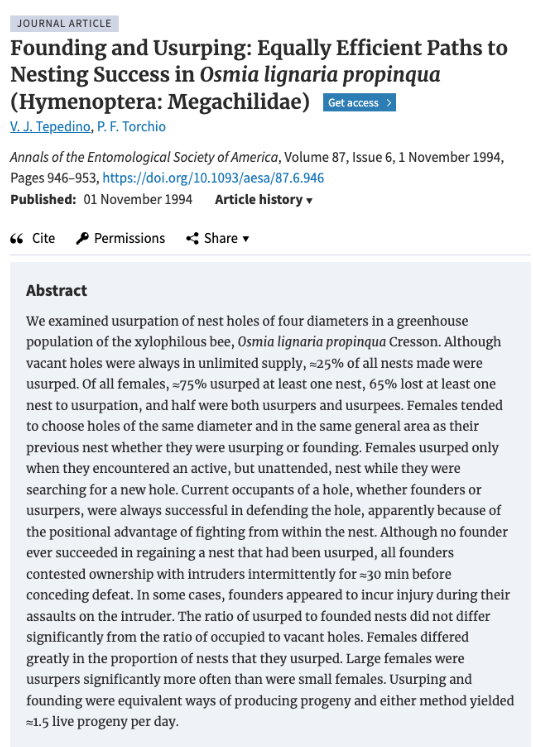
Once a Female mason bee establishes a nest will other females try to take it over? Most information says they will not. A female establishing a nest leaves a scent that warns others not to intrude. However this study says that nests are often “usurped”, perhaps 25% of the time. The new tenant will often have to fight the original owner when she returns, and the winner is usually the female that is inside the nest at the time of confrontation. The study was done by two of the top scientists in this field. My own observation is that if the bee fills the nest quickly, perhaps in two or three days the nest is unlikely to be usurped. A nest left unattended for several hours or days is much more vulnerable.
Is it always necessary to remove cocoons from the nest at the end of the season? Using loose cocoons will result in higher dispersal rates. Studies show up to 50% of females will seek nesting opportunities elsewhere versus 10% if left in its natal nest. Thus, if you can determine a particular nest is free of pests, it can remain untouched and set out the following spring as is. The bees will emerge and often re-use the nest after cleaning up the refuse. They are also more likely to use adjoining nests.
Anytime after mid-August open and examine a nest for all pests. Cells containing anything other than viable cocoons and mud walls can be cleaned out with a toothpick etc. Remove any pollen balls to eliminate food supplies. If mites are present, abandon this idea and clean the cocoons as usual. Mites can be seen with a magnifying glass or microscope. In the spring, combine this nest with empty ones and set out as usual. Of course overwintering the nest in a fridge will take considerably more room.
Do Mason Bee keepers inadvertently contribute to the Houdini fly problem? Houdini flies now seem well established in the Pacific NW. Most ardent Mason Been enthusiasts clean out their nests and kill the fly larva, so we don’t DIRECTLY contribute to the problem. However females that do not nest in their natal nests will find other nesting sources and the Houdini larva created in them will live into the following season. One reason for leaving the natal nest is that there is no more room in the nest, as all channels are full by mid-season. A “cure” for this is to provide significantly more nests than is required. In that way we do not force the bee to hunt for nests that will not be inspected and rid it of Houdini fly larva (and other pests). Too many nesting channels is never a problem.
How many brood cells can an Orchard Mason bee complete in one Day? A study watched 185 female Osmia lignaria bees in outdoor observation nests to learn how many brood cells they can make in a day. Across the season, the bees produced about 3,630 brood cells, and more than 80% were made on days when a female completed two to four cells. These “multi-cell days” happened during about 12 hours of good weather. Single-cell days mostly occurred when weather was too cold, windy, or wet for steady foraging.
The researchers found that making several cells per day is normal for healthy females, not unusual. Some females were consistently more productive than others, showing that individual differences—size, foraging skill, or energy—affect output.
Weather was the strongest factor influencing daily productivity. Warm, calm days allowed multiple brood cells; poor weather reduced or stopped activity. Overall, the study shows that O. lignaria females can routinely create several brood cells per day when conditions are favorable. The study was done by Spendal and Cane and accepted in 2022. The conclusions were summarized using ChatGPT.
Are artificial scents to keep the female Orchard Mason bee in its natal nest worth purchasing? I’ve always had doubts about this but at least one study indicates it does. Personally I think extra money spent on buying morel cocoons might be of more value. Here is a study done by AGPOLLEN, L.L.C. submitted to NRP. Summarized using ChatGPT.
Key Outputs and Findings:
- Cocoon Extract Testing: Eight field tests and laboratory bioassays were completed using different fractions of cocoon extract.
- In wildflower cages, one combination of fractions was strongly preferred in the first week of nesting.
- Y-tube studies showed that two fractions were preferred over the control.
- Synthetic Chemical Blend: Researchers tested a synthetic blend of five chemicals that was developed in collaboration with the subcontractor, Suterra, for commercial delivery.
- The synthetic blend significantly increased nesting success in multiple trials.
- Quantitative Impact of the Synthetic Blend:
- In one almond test, the blend increased established females by 1.8 fold.
- In a second almond test, it increased completed nests by 2.3 fold.
- In propagation screen-houses, it increased completed nests by 2.6 and 4.3 fold.
- In Utah apples, 20 times more cells were completed in the treated sites compared to the control nesting sites.
Conclusion:
The researchers concluded that significant progress was made toward a commercially viable nest attractant, with chemical components in three of the tested fractions showing promise. The goal for the subsequent year (2012) was to test an improved attractant blend on a large scale.
Did most Osmia lignaria vote Republican or Democrat?
Short answer: neither — turnout was extremely low due to tiny clipboards and an inability to hold a pen.
Longer answer: Blue orchard mason bees are single-issue voters. Their entire platform is:
- Early bloom security
- Universal access to mud
- Strict limits on neonicotinoids
- Zoning protection for 5/16″ nesting tunnels
They caucus briefly in March, adjourn by apple blossom peak, and then focus exclusively on pollen acquisition strategy.
If you’re wondering about party alignment, they tend to lean strongly toward whichever candidate supports:
- Native plant subsidies
- Habitat corridors
- Fewer leaf blowers
However, internal polling suggests they are fiercely independent. They reject party labels and instead identify as:
“Pro-forage, anti-parasite, temperature-triggered moderates.”
Also worth noting: males do a lot of buzzing early in the season but have limited long-term impact on outcomes.
In the end, every election cycle they reach the same conclusion:
It’s not about red vs. blue.
It’s about blue flowers in early April. 🐝
 My Mason Bees