
Mason bees require pollen and nectar to feed themselves and their young. Nearby sources will keep them close to home, especially when they emerge from their cocoons. Fruit trees, woody plants and shrubs are a major source, but forbs, (non-woody, broad-leaved flowering plants) can be an important supplement. The following will produce blossoms very early in the spring if planted in the fall or late winter.
This page identifies some forbs specifically chosen to fit the needs of the Orchard Mason Bee. They have been chosen from studies designed for orchard mason bee propagation and must fit all of the following criteria:
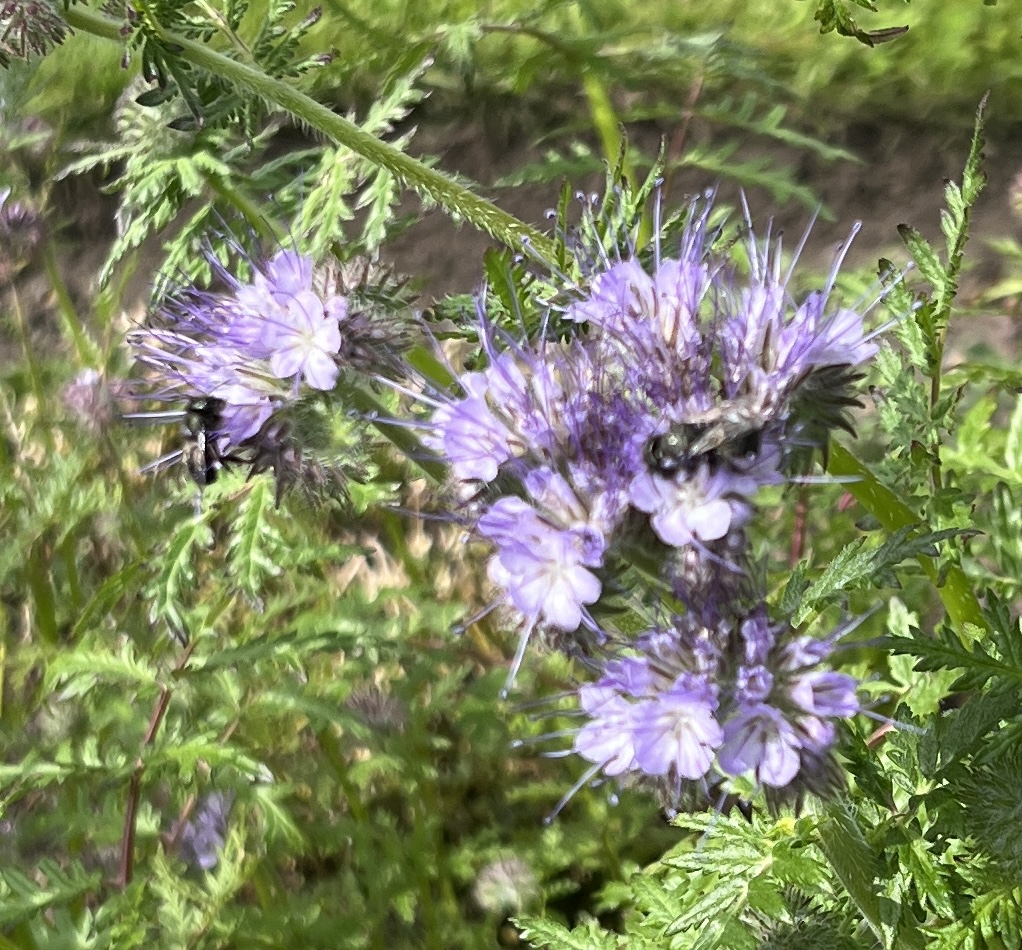
Lacy Phacelia
Must Have’s
- Bloom in late winter or very early spring.
- Provide ample quantities of pollen and nectar.
- A flower shape that can be accessed by the Orchard Mason bee.
- Suited to the Pacific Northwest.
- Be close to the nest. The closer the better.
Few flowers fit all of these categories, but some stand out and have been tested in commercial orchards in scientific studies. Some are available from local seed outfits, others may require some searching.
Forbs for the Mason Bee
- Five Spot (Nemophila maculata)
- Baby Blue eyes (Nemophila menziesii)
- Lacy Phacelia (Phacelia tanacetifolia)
- Aubrieta (Aubrietia deltoidea)

Five spot nemophila & 2 Orchard Mason Bees
- The best time to plant these flowers is in the fall. They will overwinter at an early stage and bloom when conditions are right. If by chance they do not, a second seeding can be done in late winter.
- Try and plant as large a plot as possible. Bees look for a destination patch of blooms that will service many bees at the same time and can be returned to several times a day. I have found a 20 square foot patch (4 ft. by 5 ft.) to successfully attract large numbers all through the day.
- Studies show the Lacy Phacelia and Baby Blue eyes may be the best nutritionally. My experience is that the Five spot is the most visited by Mason bees, while the Lacy Phacelia also attracts the most bumblebees and honeybees.
- Lacy Phacelia grows to about 18 to 24 inches. Five Spot and Baby Blue eyes are about 5 to 7 inches, and the Aubrietia is a ground hugger.
- Lacy, Five Spot and Baby Blue Eyes are annuals but re-seed exceptionally well if left in place to dry after blooming. The Aubrietia is a perennial. It makes great ground cover and will spread slowly.
- Another Forb which may be as good or better than those listed above is the Douglas Meadowfoam. It blooms very early, has copious amounts of pollen and nectar, and a flower shape very attractive to the Orchard Mason bee. I have found seeds difficult to obtain, and have yet to test it in my backyard. Hopefully, by next spring I can observe how it compares to the top choices.
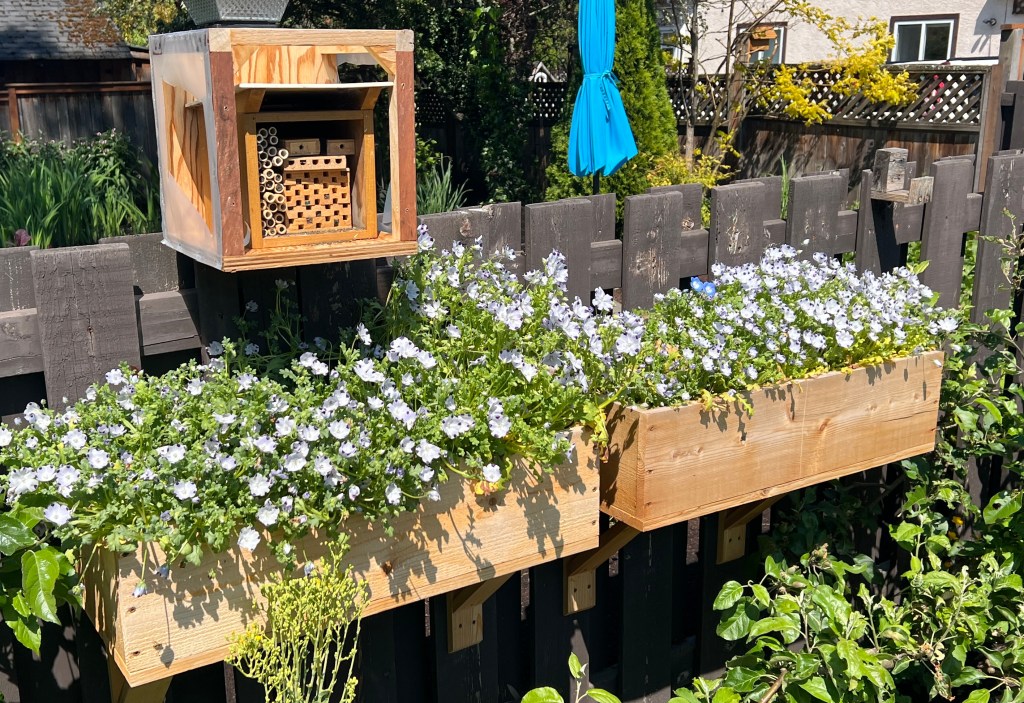
Boxes of 5 Spots. (Find the 2 Baby Blue that got mixed in).
Additional notes on Forbs from a study by Natalie K. Boyle et al., published in Ecology & Evolution in 2020, and summarized using ChatGPT.
This study showed that giving Osmia lignaria (blue orchard mason bees) access to wildflower plantings greatly improves their nesting and reproduction in commercial orchards. Bees travelled up to 800 m to collect pollen from these plantings, and most successful nesting happened along orchard edges. Edge nests closest to the wildflowers produced the most healthy offspring, suggesting that the combination of edge location and nearby forage is ideal.
Even when some nests inside the orchard were technically closer to the flowers, bees still did better at the edges. Edges likely help because they offer more sunlight, better visibility, and strong visual landmarks for bee navigation. Wildflower plantings continued to support bees for weeks after the almond bloom ended, providing diverse pollen—especially Phacelia, which bees strongly switched to once almond flowers were gone. This did not reduce almond pollination because females still gathered plenty of almond pollen during bloom.
Drought played a major role: bees need mud for nest-building, and reproduction was far lower in the drier year until orchard managers provided water. Overall, small wildflower plots near nesting sites significantly boosted bee survival and reproduction. The study suggests growers should install small, bloom-overlapping wildflower patches near orchard edges and ensure mud availability to get strong pollination and lower long-term costs.
 My Mason Bees