
- Types of materials
- Opening configurations
- Inserts for nest channels
- Assembly Mason Bee Nesting blocks
- Emergence boxes
Types of materials

Solid wood nests are most conveniently made with 1inch stock lumber, from 1x 2″ to 1x 8″. The wider the board, the greater the possibility of warping over time. Best recommendation: Use 1x 4″ boards with 5 square openings. The actual size of the board will be about 3 1/2″ by 3/4″.

Tube nests must be destroyed when cleaning the nests unless an insert (parchment paper, etc.) is also used. Thin wall cardboard and Reeds with thin walls are subject to Chalcid wasp attacks. Thick wall cardboard usually has to have the back end sealed, and is difficult to open. Bamboo is tough but can be opened easily when a utility knife is tapped. Best recommendation: Bamboo. A free supply is often available. Thick wall cardboard with an insert works but the opening will be on the small side.
Opening configurations
The Mason Bee will be transporting a lot of mud into her nest to seal off each cell. Round holes require about 5 trips to seal a cell, while square holes require 9. Conversely, a square hole provides about 30% more space which may allow the female to be more efficient. Square holes are the easiest to make, using a table saw, preferably with a dado blade. Round holes require a 6″ bit, and a drill press will make it much easier. Arched holes require a 5/16″ round nose bit and a router with table, or possibly a shaper. Best recommendation: Square holes. I’ve always found them the most utilized (marginally) and easiest to construct.
The opening for Orchard Mason Bees should to 5/16″ or 8 mm. Slightly larger holes are fine but smaller openings encourage more male propagation and females may have difficulties maneuvering due to their size. Sometimes the result of larger openings will be cocoons that fit at an angle in the cell, resulting in more cocoons per channel. The length of the channel should be about 6″, although a little shorter or longer lengths are not a problem.
Inserts for nest channels

Inserts can be placed in any shape of channel, but normally are used in reeds, bamboo or cardboard & plastic nests. Using them allows the original material to be reused. Inserts can be purchased but are easily and cheaply made. Parchment, wax paper or other thin paper can be cut to a length of the channel. The width should allow it to be rolled several times around a dowel (possibly pencil). Insert the dowel and paper into the opening and when the dowel is removed the paper will expand to fit the opening.
Cleaning is simple as the contents readily fall out when the insert is unrolled. Disadvantages are that moisture can be a problem if the material cannot breathe. It is difficult to examine the contents due to the “memory” of the paper wanting it to roll back up. Occasionally the bee will spend time chewing on the edge of the paper. The thickness of the paper will reduce the size of the hole so it is wise to use a larger hole to begin with, perhaps 3/8″ rather than 5/16″.
Store bought inserts are often made of plastic, but paper types are better. The openings may be a bit on the smaller size, but they will work.
Assembly Mason Bee Nesting blocks
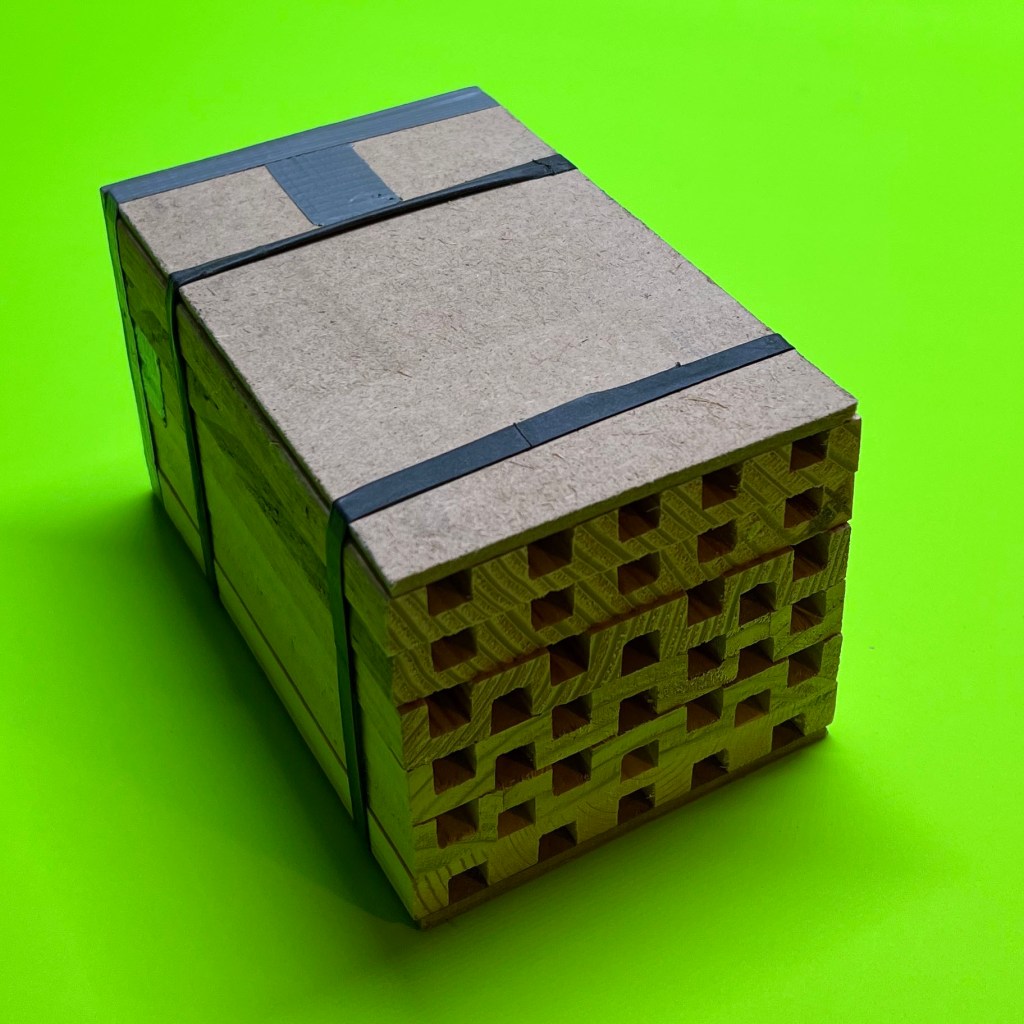
Make a “sandwich” of several trays. It should be large enough to almost fill the house. Any extra space should be filled with a material that will prevent bees and pests from entering. Bind the trays tightly with tape, zip ties, string etc. In this case I used bike tubes cut 1/4″ wide. Commercial nests can be purchased on the WEB.
The back of the nest must be sealed to prevent pests, especially Chalcid wasps from infecting the cocoons. Use 1/8″ ply, hardwood or other material for the barrier. Seal all the edges with tape, in this case I used duct tape.


If the nests do not fill the house, bamboo or other tube nests can take up the extra space. In this case an emergence box is sandwiched between the bamboo and the slot nests. A small hole will allow them out of the box and the bee will be surrounded by empty nests, an invitation to stick around and not try to find a new home. Because the emergence box is 3/8″ high, bees will often nest in after all the other channels are filled.
Emergence boxes
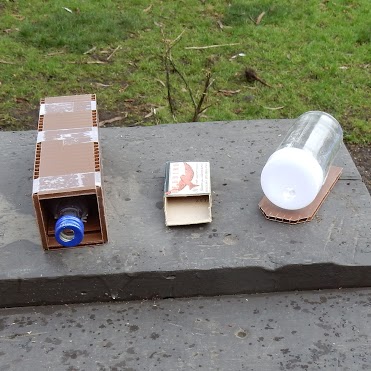
There are many types of emergence “boxes”, mostly improvised. Purchased bees usually come in small cardboard containers such as match boxes. Pill vials and mini liquor bottles can be used. Anything that you can attach it to the house is fine. I prefer to embed the container inside the house so they are adjacent to the empty nests, preventing unnecessary dispersal. A small hole, around 1/4″ must be located at the front. The box can be removed 2 or 3 weeks after they emerge after checking that the cocoons are empty.
Emergence boxes are easy to make. The matchbox shown can easily hold 20 cocoons. Be sure the height is at least 3/8″. Too much space is not a problem but don’t cramp them too much. If they are not going to be put inside the house they can be attached to it by double sided tape etc. The round tube is 3/4″ plastic pipe. A piece of bamboo wrapped with duct tape makes it fit snugly into the opening.

 My Mason Bees