
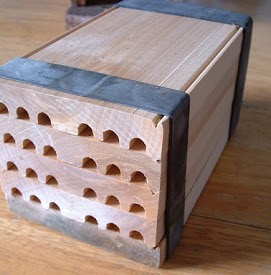

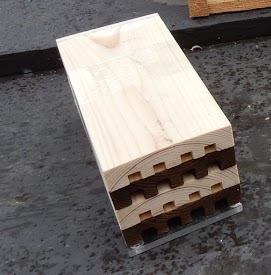
Orchard Mason Bee Nesting trays. Traditionally a board with long grooves in which the Mason Bee lays its eggs and prepares them for life. The accepted optimal length is 6 inches, and this is important as the Bee lays females in the back of the channel and males in the front, slightly favoring the males in number. A channel that is too long or too short may disturb this ratio. The accepted size of the channel is 5/16 inch. This allow the Bee to work and turn, but limits the amount of mud required to separate her offspring, giving her more time to produce new eggs.
Commercially produced trays are available, generally about 6″ long, 4″ wide and 3/4″ thick. They usually have 6 or more slots, 5’16” in diameter. By stacking several together a good size nest is achieved. A perfect circle (right) is likely the optimal, with an arched opening (left) being very close behind. A square opening (below) is a very close third. Less mud is required for the circle but the amount is not great.
Much argument is to be had over the material used for the trays. Wood is the most popular, but I have seen plastic trays full to the brim. Some argue Cedar should not be used, while some suppliers sell only Cedar and swear by their results. Its my own opinion that new wood should to aged at least a few months to rid it of strong aroma’s. In nature the Mason Bee often use holes bored by other insects or cracks in shrinking wood, so the wood is likely a few years old. I give my nesting trays a bath of very muddy water to darken them a bit and minimize the “new” smell.
Building Your own:
Start with 25″ or more length of wood, then cut all your grooves. Cut the wood into 6″ sections for the final product. This avoids working with small pieces of wood in high speed machines. Finally, carefully sand all the grooves so that all edges are smooth. I emerge the final product in a sloppy mix of garden soil and water (mud) for a couple days to darken it a bit, and to combat the “new” smell. Mason bees don’t like new.
Bee’s may not utilize the tray if the channels are open to the rear. Use thin plywood or heavy paper/cardboard to seal off the rear of each tray. Alternatively if you have a stack of trays, one piece can seal them all off.
Home made nesting trays are very cost effective. Cheap lumber grades, such as pine are fine, and readily available as 1×4 and 1×6. Anything wider may tend to warp. Used wood is fine, in fact older wood will have less “new” wood smell. Try and pick pieces that have vertical end grain to prevent warping.
The slots can be cut with a table saw, although this takes very careful measuring and care to get the 5/16″ openings properly spaced. I use a router and router table with a 5/16″ square end bit. A “bullnose” bit would be preferred to give an arched opening, but I have been unable to find one.
In the above example to the right, the 2 dark trays were burned with a blowtorch. Might be effective, but overkill. A 3/16″ plexiglass sheet was added to the bottom so the progress can be viewed from time to time. Normally any thin sheet of wood, plywood, or coroplast can be added to the bottom to seal it off.
Alternative Nesting trays
A problem with traditional nesting trays is that they tend to warp. The wider and thinner they are, the greater this problem. For example a 1 x 6 will warp easier than a 1 x 4. A 2×2, 2×4 or 4×4 tend to have the least warpage.


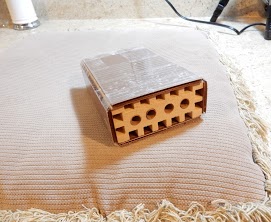
The tray on the left demonstrates the warpage problem. The 2 x 4″ tray on the right is much less subject to warping and also inhibits the travel from one channel to another. It would be wrapped on all 4 sides with coroplast. The round holes in the middle must have paper inserts, which you can roll yourself.
 My Mason Bees
Good morning.
I would like to make the mason bee trays myself with a milling machine. Do you have a YouTube instructional video explaining how I can mill these trays myself with milling machine?
LikeLike